How Do We Mitigate Ethical Risk?
by Victoria McKenney, Deputy General Counsel - Reg and Compl & Dep Chief Compl Officer
July 25, 2022
It seems every year a new corporate scandal rocks everyone from Wall Street to Main Street. For companies, the repercussions can be severe: enforcement actions, lawsuits, civil and/or criminal penalties, and reputational damage. While no organization is immune, is U. S. Steel at risk?
A few years back, Harvard Business Review published an article written by Alison Taylor titled, “5 Signs Your Organization Might Be Headed for an Ethics Scandal.” Consulting with investigators, regulatory monitors, and academic experts, Taylor identified these five factors that, when one or more are present, could indicate that a company is heading for an ethics scandal: (1) decision-making driven by urgency and fear, (2) isolation of groups, (3) lack of accountability, (4) a culture that celebrates success by any means necessary, and (5) language and jokes that cover up wrongdoing.
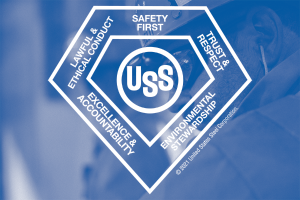 And again, while no organization is immune to these factors, U. S. Steel’s culture is decidedly different. We have an excellent and strong tone at the top, set forth by our CEO, Dave Burritt, and echoed by the senior leadership team that sets the stage for everything we do. We stress that our work is guided by our S.T.E.E.L. Principles and any significant business decision is approved only after a thorough and analytical decision-making review with input from many different stakeholders. In accordance with our “Excellence and Accountability” S.T.E.E.L. Principle, we expect every employee to be held accountable for their actions. We emphasize doing business the right way and that no success is worthwhile if our “Safety First” or other S.T.E.E.L. Principles are compromised. We are transparent about our decisions, our strategy, and our safety and environmental goals. We work in cross-functional teams and encourage diverse of points of view. And in fact, the work we do has earned our company a place as one of the 2022 World’s Most Ethical Companies by Ethisphere, a global leader in defining and advancing the standards of ethical business practices.
And even with all that, there’s still more we can do to mitigate ethical risk. As Taylor notes, each of us can make sure that we are having frequent conversations with our team members. Managers should check in often with their employees, regardless of location, to make sure they feel connected to our company, our strategy, and our core values. We should encourage each other to ask questions and report any concerns to supervisors, Human Resources, Corporate Security, or the myriad of other resources available, including our hotline. . We should solicit and offer feedback, in assessments, surveys, and other tools that we utilize. As Taylor notes, these types of conversations and feedback mechanisms can help us better understand the risks inside our organization and take additional steps to mitigate them.
Achieving Best for All® certainly requires the best from all of us, and that’s a culture and environment rooted in our S.T.E.E.L. Principles.
About the author
Victoria McKenney is Deputy General Counsel, Regulatory & Compliance and Deputy Chief Compliance Officer.
Forward-Looking Statements:
This webpage
contains information that may constitute "forward-looking
statements" within the meaning of Section 27A of the
Securities Act of 1933, as amended, and Section 21E of the
Securities Exchange Act of 1934, as amended. We intend the
forward-looking statements to be covered by the safe harbor
provisions for forward-looking statements in those
sections. Generally, we have identified such
forward-looking statements by using the words "believe,"
"expect," "intend," "estimate," "anticipate," "project,"
"target," "forecast," "aim," "should," "will," "may" and
similar expressions or by using future dates in connection
with any discussion of, among other things, the
construction or operation of new or existing facilities or
operating capabilities, the timing, size and form of share
repurchase transactions, operating or financial
performance, trends, events or developments that we expect
or anticipate will occur in the future, statements relating
to volume changes, share of sales and earnings per share
changes, anticipated cost savings, potential capital and
operational cash improvements, changes in the global
economic environment, including supply and demand
conditions, inflation, interest rates, supply chain
disruptions and changes in prices for our products,
international trade duties and other aspects of
international trade policy, statements regarding our future
strategies, products and innovations, statements regarding
our greenhouse gas emissions reduction goals, statements
regarding existing or new regulations and statements
expressing general views about future operating results.
However, the absence of these words or similar expressions
does not mean that a statement is not forward-looking.
Forward-looking statements are not historical facts, but
instead represent only the Company's beliefs regarding
future events, many of which, by their nature, are
inherently uncertain and outside of the Company's control.
It is possible that the Company's actual results may
differ, possibly materially, from the anticipated results
indicated in these forward-looking statements. Management
believes that these forward-looking statements are
reasonable as of the time made. However, caution should be
taken not to place undue reliance on any such
forward-looking statements because such statements speak
only as of the date when made. Our Company undertakes no
obligation to publicly update or revise any forward-looking
statements, whether as a result of new information, future
events or otherwise, except as required by law. In
addition, forward-looking statements are subject to certain
risks and uncertainties that could cause actual results to
differ materially from our Company's historical experience
and our present expectations or projections. These risks
and uncertainties include, but are not limited to, the
risks and uncertainties described on this webpage and in
"Item 1A. Risk Factors" in our Annual Report on Form 10-K
and those described from time to time in our reports filed
with the Securities and Exchange Commission.