U. S. Steel President and CEO Dave Burritt Delivers Keynote Address at the African American Chamber of Commerce of Western Pennsylvania’s Annual Luncheon - www.ussteel.com
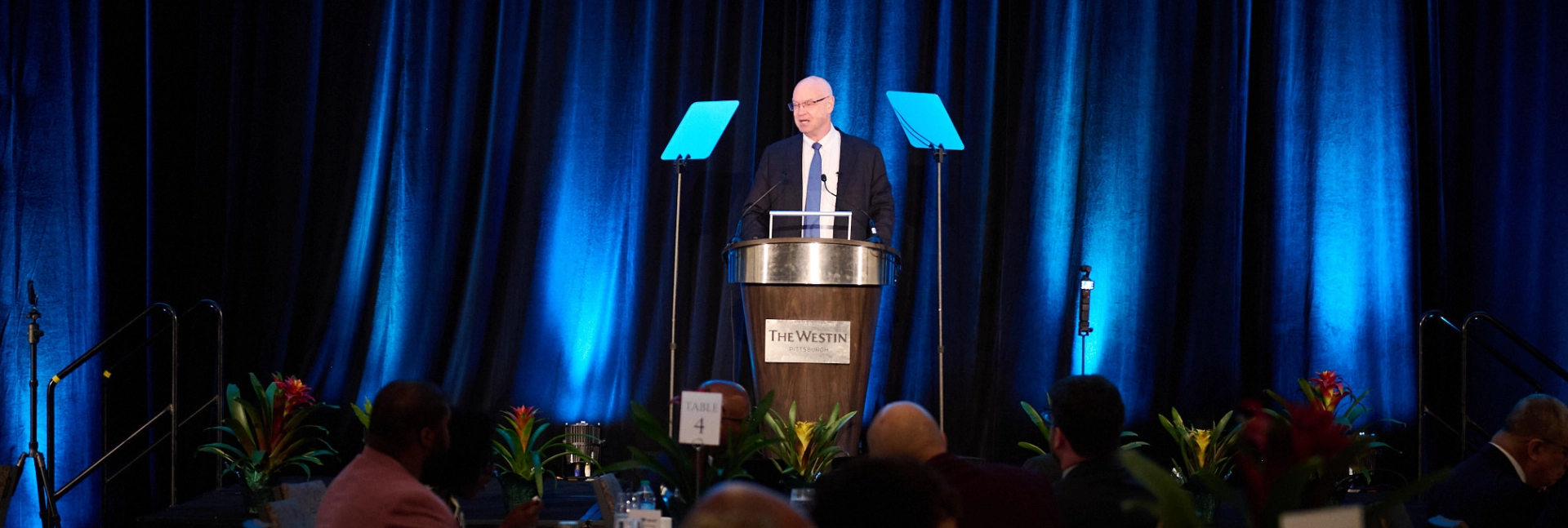
U. S. Steel President and CEO Dave Burritt Delivers Keynote Address at the African American Chamber of Commerce of Western Pennsylvania’s Annual Luncheon
Jun 18 , 2026
Keynote Address at African American Chamber of Commerce of Western Pennsylvania’s Annual Luncheon
They said Pittsburgh was no longer a steel town.
They said the Mon Valley's best days were behind it.
They said investment would go somewhere else.
They said manufacturing's future belonged somewhere else.
They said the next generation would have to leave Western Pennsylvania to find opportunity.
And yet, not long ago, I was talking with one of our employees in the Mon Valley.
He's a multi-generational steelworker. His father worked at U. S. Steel. So did his grandfather.
We were talking about the partnership with Nippon Steel, the investments we're making, and what all of it could mean for the future. And he told me something that stuck with me. He said, "For the first time in a long time, I feel confident that my kids … and maybe even my grandkids … will have the same opportunity I had."
Not a guarantee … not a promise.
An opportunity.
And when he said that, it reminded me what's really at stake here. Because this isn't just about steel. It's not just about a mill. It's not just about an investment.
It's about whether the next generation believes there is a future for them in communities throughout the Mon Valley.
It's about whether a young person can look at where they grew up and see opportunity instead of having to look somewhere else.
In other words…enough with the past tense. Today, I want to talk in the future tense.
But before I do that, I want to talk a little about my own past.
When I was a kid, my brother and I delivered newspapers. Then we “graduated” to mowing lawns. Then baling hay. Then shoveling manure.
Talk about climbing the corporate ladder…
But in those early years, I learned something simple: Hard work usually gets rewarded. Not always immediately. But over time, hard work wins.
I feel that spirit here in Pittsburgh.
Now, part of the reason I feel so strongly about this region goes back to the very first time I visited.
Like a lot of people who aren't from here, I knew some of the stereotypes. I knew it was steel town…with bridges and three rivers. I knew there was something about putting French fries inside sandwiches.
But I had never actually seen Pittsburgh for myself.
Then, on my first visit, I came through the Fort Pitt Tunnel at night. And suddenly there it was. The skyline. The rivers. The bridges. The entire city opening up in front of me.
And I remember thinking: "The Man of Steel really does live here."
Now, admittedly, that may not have been the most sophisticated observation I've ever made. In fact, after hearing that story, you may understand why I don't do much of the driving anymore.
But what struck me wasn't just how beautiful the city was. It was that sense of possibility. Of a glorious past…and a future yet to be written.
I believe the future of the Mon Valley is still being written. I believe the future of Western Pennsylvania is still being written. And I believe U. S. Steel has an important role to play in helping write that next chapter.
Now…before I go on…
Thank you to the African American Chamber of Commerce of Western Pennsylvania for inviting me to join you today. It is an honor to be here.
The work this organization does matters. You help entrepreneurs launch businesses. You help companies grow. You create connections, open doors, and create opportunities. Most importantly, you help ensure that economic growth reaches more people, more communities, and more families.
That mission matters because when we talk about economic development, we're really talking about people.
Which brings me back to the Mon Valley.
For more than 125 years, U. S. Steel has been part of the story of Western Pennsylvania. Our company was born here. Generations of families built careers here. Entire communities grew alongside our facilities. The story of U. S. Steel and the story of this region have always been connected. In many ways, they’re the same story.
And that's why the decisions we make matter. That's why the investments we make matter. And that's why the partnership between U. S. Steel and Nippon Steel matters.
Now, I know many people followed the story of our partnership closely. Some supported it. Some had questions. Some had concerns. And that's understandable.
When people care about jobs, they should ask questions. When people care about communities, they should ask questions. When people care about the future of American manufacturing, they should ask questions.
So let me tell you what this partnership means to me: It means commitment. It means investment. It means growth. It means opportunity.
Over the next several years, we expect to invest approximately $14 billion across our footprint. That includes nearly $11 billion of committed investments through 2028. Those investments are a direct result of our partnership.
These are transformational investments. Investments designed to modernize facilities, improve competitiveness, expand capabilities, and create opportunities for generations to come.
Investments we will deliver while putting safety first.
And nowhere is that commitment more visible than in the Mon Valley.
We are planning approximately $2.5 billion of investment here. That includes a new state-of-the-art hot strip mill that will replace equipment dating back to 1938.
Now, whenever I tell people we're replacing equipment from 1938, they usually look surprised. Then I remind them that some of that equipment is almost as old as I am. That usually gets a better reaction.
This investment is expected to support thousands of jobs and generate significant economic activity throughout the region.
But what excites me most isn't the number. It's what the number represents.
Because every investment is a vote of confidence: A vote of confidence in workers. A vote of confidence in communities. A vote of confidence in the future.
And while those investments will directly benefit U. S. Steel, our employees and our customers, the opportunity extends far beyond our facilities.
Because a project of this scale creates opportunities throughout an entire regional economy. Construction firms. Engineering firms. Technology companies. Transportation providers. Professional service firms. Small businesses. Entrepreneurs.
That’s one of the many reasons that I am excited to spend time with you today.
Because many of the businesses that will help shape that future are represented in this room.
And that's why I want to spend a few minutes talking about something that doesn't always make headlines when people discuss major industrial investments…
Procurement.
Supplier opportunities.
And making sure local businesses have a seat at the table.
When people hear about a multi-billion-dollar investment, they naturally focus on the physical assets. They think about mills, equipment, construction projects, and infrastructure.
Those things are certainly important. But what often gets overlooked is the economic ecosystem that surrounds an investment of this scale.
Every major project creates opportunities for contractors, suppliers, logistics providers, engineering firms, technology companies, professional service firms, construction companies, and countless small businesses that help make large-scale projects possible.
The impact extends far beyond the gates of our facilities.
The African American Chamber has built an incredible network of entrepreneurs and business leaders. Many of the companies represented in this room have the talent, expertise, and capabilities to help support the next chapter of manufacturing in Western Pennsylvania.
We want those businesses to understand that opportunity exists.
And we want them to know how to engage with us.
In fact, one of our guiding principles is simple: Whenever possible, we want to invest in the Mon Valley. Whenever possible, we want to invest in Western Pennsylvania. Whenever possible, we want to work with local businesses.
And that’s not merely an aspiration. It's something we're already doing.
Last year, U. S. Steel spent approximately $156 million with minority-owned businesses. We spent approximately $248 million with woman-owned businesses. We spent approximately $19 million with veteran-owned businesses. And we spent more than $205 million with small businesses.
Those are significant numbers, yes. But I don't view them as a finish line. I think they’re the starting line. Because there is more work to do…more businesses to engage…more relationships to build.
We want to work with you. We want to know what you do. We want to understand your capabilities. And we want to create more pathways for local businesses to participate in the growth that lies ahead.
As I was preparing for today, I spent some time looking at the mission of the African American Chamber. What struck me wasn't simply the focus on business development and economic opportunity. It was the broader vision.
Improving business and professional opportunities. Providing educational programs. Supporting mentoring. Promoting empowerment and self-sufficiency. Creating greater access to economic opportunity.
Because at the end of the day, that's what economic development is supposed to accomplish. It's about creating opportunities for people.
One area where I believe we have an opportunity to do more together is workforce development.
As many of you know, we have employees here today representing Leveraging and Enhancing All Diversity … “LEAD”… one of U. S. Steel's employee resource groups. LEAD plays an important role in helping us develop talent, strengthen leadership, and create opportunities throughout our company.
As we continue investing in the Mon Valley, I believe there is an opportunity to build stronger connections between organizations like this Chamber, our LEAD employees, local schools, workforce development organizations, and U. S. Steel.
Because the future workforce doesn't simply “appear.” It has to be developed. It has to be mentored. It has to be encouraged. And it has to see opportunity.
That's something I hope we can explore together in the years ahead.
Because as important as investment is, investment alone is not enough. Projects succeed when relationships are strong. They succeed when communities are engaged. They succeed when people believe they have a voice in the future that is being created around them.
Over the last year, I have spent a great deal of time meeting with community leaders, elected officials, business owners, residents, and employees throughout the Mon Valley.
I've learned a lot from those conversations.
What I hear most often is that people want to be included. They want transparency. They want partnership. They want to know they have a stake in what comes next.
I think that's entirely reasonable.
The future of the Mon Valley shouldn't be something that happens to the community. It should be something that is built with the community.
That requires trust…and trust is built one conversation at a time.
That spirit of partnership is one of the reasons I want to recognize a few people.
That begins with Governor Josh Shapiro. The Governor has been a strong advocate for manufacturing, economic development, and Pennsylvania workers. He understands that if we want to create opportunity, we must continue to compete for investment. We appreciate his support and his commitment to ensuring Pennsylvania remains a place where manufacturers can grow and succeed.
County Executive Sara Innamorato has been a tremendous partner. She understands that economic development and community development are not competing priorities: they are the same priority. Her administration has worked constructively to help move important projects forward, navigate challenges, and create an environment where investment can occur. We are grateful for her leadership and partnership.
The truth is, none of these projects happen alone. The strongest regions are the ones that work together: government, business, community organizations, all rowing in the same direction.
And when I look around Western Pennsylvania, I see enormous potential. I see world-class universities. I see world-class workers. I see world-class businesses.
I see a region that has every ingredient necessary to win.
People occasionally ask me why I'm so optimistic. After all, if you turn on the television, there's usually somebody telling you why everything is terrible. And if you spend enough time on social media, you'll discover that apparently civilization is ending every Tuesday afternoon.
Yet somehow, every Wednesday morning, we're still here.
Building. Working. Investing. Creating.
Sometimes the best thing you can do is shut out the noise and get to work.
So let me close where I began.
For too long, people have talked about the Mon Valley in the past tense. They talked about what it used to be … what it used to make…what it used to represent.
But I believe the future deserves equal attention.
I believe in the employees who show up every day determined to build something better.
I believe in the educators and mentors preparing the next generation.
I believe in the community leaders fighting for opportunity.
I believe in the businesses represented in this room.
And most of all, I believe in the people of Western Pennsylvania.
Because the future is not something we inherit. The future is something we build. We build it through investment. We build it through partnership. We build it through innovation. We build it through hard work. We build it through trust.
And we build it by believing in one another.
That is what this moment is about: a renewed belief in what this region can become.
A stronger Mon Valley. A stronger Western Pennsylvania. A stronger manufacturing base. A stronger economy. And a stronger future for the generations that will follow us.
The story of this region is not over. The next chapter is waiting to be written. And when we write it together, I believe it will be the best one yet.
About the author
Forward-Looking Statements:
This webpage contains information that may constitute "forward-looking statements" within the meaning of Section 27A of the Securities Act of 1933, as amended, and Section 21E of the Securities Exchange Act of 1934, as amended. We intend the forward-looking statements to be covered by the safe harbor provisions for forward-looking statements in those sections. Generally, we have identified such forward-looking statements by using the words "believe," "expect," "intend," "estimate," "anticipate," "project," "target," "forecast," "aim," "should," "will," "may" and similar expressions or by using future dates in connection with any discussion of, among other things, the construction or operation of new or existing facilities or operating capabilities, the timing, size and form of share repurchase transactions, operating or financial performance, trends, events or developments that we expect or anticipate will occur in the future, statements relating to volume changes, share of sales and earnings per share changes, anticipated cost savings, potential capital and operational cash improvements, changes in the global economic environment, including supply and demand conditions, inflation, interest rates, supply chain disruptions and changes in prices for our products, international trade duties and other aspects of international trade policy, statements regarding our future strategies, products and innovations, statements regarding our greenhouse gas emissions reduction goals, statements regarding existing or new regulations and statements expressing general views about future operating results. However, the absence of these words or similar expressions does not mean that a statement is not forward-looking. Forward-looking statements are not historical facts, but instead represent only the Company's beliefs regarding future events, many of which, by their nature, are inherently uncertain and outside of the Company's control. It is possible that the Company's actual results may differ, possibly materially, from the anticipated results indicated in these forward-looking statements. Management believes that these forward-looking statements are reasonable as of the time made. However, caution should be taken not to place undue reliance on any such forward-looking statements because such statements speak only as of the date when made. Our Company undertakes no obligation to publicly update or revise any forward-looking statements, whether as a result of new information, future events or otherwise, except as required by law. In addition, forward-looking statements are subject to certain risks and uncertainties that could cause actual results to differ materially from our Company's historical experience and our present expectations or projections. These risks and uncertainties include, but are not limited to, the risks and uncertainties described on this webpage and in "Item 1A. Risk Factors" in our Annual Report on Form 10-K and those described from time to time in our reports filed with the Securities and Exchange Commission.