Steel's Age of Realignment: Dave Burritt at the Global Steel Dynamics Forum - www.ussteel.com
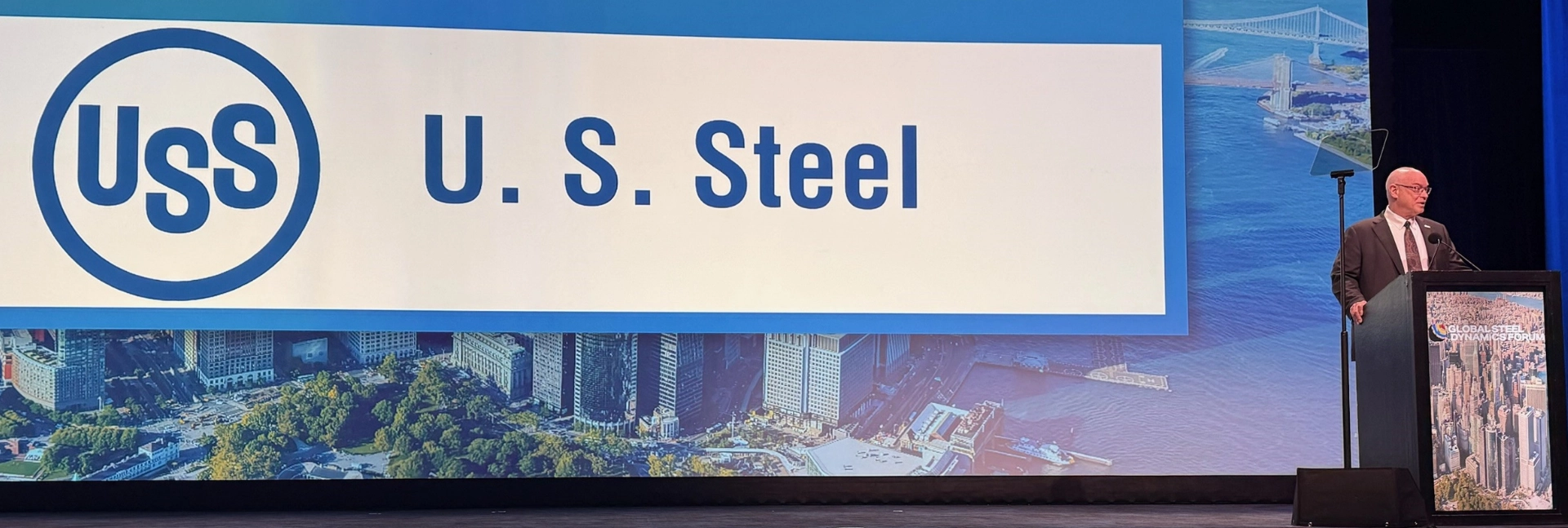
Steel's Age of Realignment: Dave Burritt at the Global Steel Dynamics Forum
Jun 17 , 2026
Dave Burritt’s Speech at Global Steel Dynamics Forum
They said this deal couldn't happen.
They said the politics were too difficult.
They said the scrutiny was too intense.
They said the obstacles were too great.
They said the uncertainty would be overwhelming.
They said the transaction would never make it across the finish line.
They said we should walk away.
They said we should lower our ambitions.
They said we should settle for less.
They said, they said, they said…
Did we listen to what they said?
Thank you…
Thank you to everyone for being here.
And especially…thanks to all of you who believed in us.
At U. S. Steel … all along … we believed in the future of American steelmaking. We believed in the strength of U. S. Steel and Nippon Steel. And we believed in the value of bringing together two great steel companies.
And most importantly, we believed that if something is worth doing … it is worth fighting for.
So we stayed the course … we listened…we adapted … and we engaged.
We built support one conversation at a time, one community at a time, one stakeholder at a time.
Including one very important stakeholder…the president of the United States of America.
I met with President Trump in the Oval Office in early 2025, after President Biden had blocked the deal. And I can tell you, that meeting did not begin exactly the way I hoped.
When I walked in, I looked around the room and saw a couple people I had not expected to be there, including Howard Lutnick, who had yet to be confirmed as Commerce Secretary, and Peter Navarro, who is well known for being “America First…and only.”
Neither of them were pro-deal.
And then the first thing President Trump said was, “You know, I was against this deal before Biden. Biden copied me.”
And I thought…well, this is going to be a short meeting.
But as the meeting unfolded, it was frankly fascinating.
The President was on his game … clearly in negotiation mode … moving quickly from topic to topic, putting me in, let’s say…an uneasy position at times.
Mr. Navarro asked, “Why do you even need this deal? Your stock’s going to go up anyway.”
The President talked about tariffs…about regulation…about how we didn’t really need Nippon.
And I’m sitting there trying to get my points in …the points we had worked on, the points we had rehearsed with Nippon Steel … while the conversation is moving everywhere.
At one moment, we’re talking about trade.
The next moment, we’re talking about regulation.
The next moment, he’s pointing to pictures on the wall.
And I’ll be honest … I was concerned. I thought I might be calling Nippon Steel at 4 am their time and telling them the deal was dead.
But eventually, things started to shift. He did what his predecessor wouldn’t. The president listened. He listened when I told him the workers of U. S. Steel supported this deal.
Eventually, he offered me a medallion he said was made of U. S. Steel. He asked if I wanted a picture. Of course I said yes.
And as the meeting was wrapping up, he said, “work with Howard.”
So I’m thinking…maybe we have a path here.
And right as I’m walking out, in walks Mark Zuckerberg with his entourage.
I get introduced, and the President says, “That’s David Burritt. We’re going to be doing some great things with U.S. Steel. Yeah, that good-looking guy there.”
And I thought…you know what…maybe we’ve got a chance. Because when the President calls you good-looking… that’s got to be a good sign, right?
And, of course, if the president says it…you know that it’s true.
That was really just the beginning.
Because from that point forward, we were effectively negotiating every single day, trying to get this across the finish line.
We had a big event on May 30th 2025 with the president at one of our mills outside of Pittsburgh. Thousands of employees. A major moment. It felt like a celebration…almost like a wedding reception before the wedding. Because the deal wasn’t actually approved yet.
And then, that night, when the president got back to Washington, he got off Air Force One. A reporter put a microphone in his face and asked him … “Are you going to approve the U. S. Steel-Nippon deal?”
And he said: “I don’t know. I haven’t seen the final agreement.”
So from May 30…to June 18… we were negotiating, working with Secretary Lutnick and his team at Commerce. Until June 18…the last day the deal could be approved…the partnership was finalized.
That was a year ago tomorrow…
Wow.
You know, when I was a kid, my brother and I delivered newspapers. Then we “graduated” to mowing lawns. Then baling hay. Then shoveling manure.
Talk about climbing the corporate ladder…
But in those early years, I learned something simple: Hard work usually gets rewarded. Not always immediately. But over time, hard work wins.
And that’s what happened here.
Teamwork wins, too. No deal like this gets done because of one meeting or one person alone.
So, I have a lot of people to thank.
First and foremost, thank you to our employees at U. S. Steel, especially the steelworkers. They are the true heroes of this story.
Thank you to our partners at Nippon Steel, especially Vice Chairman Mori and the entire leadership team.
Thank you to the leadership team at U. S. Steel. There were moments when this process tested all of us. Through it all, they remained focused, professional, and determined. They even managed to calm me down … sometimes.
Thank you to President Trump, Secretary Lutnick, David Shapiro and others who spent countless hours working through complicated issues and helping find a path forward.
Thank you to local leaders, especially Senator McCormick, Governor Shapiro, Representative Meuser, Senator Ward, and the incredible mayors of the towns throughout the Mon Valley, and Northwest Indiana.
Thank you to Ron Ashburn and Philipp Englin. First, for having me. Second, for putting on another wonderful conference.
When it came to our deal, Ron and Philipp understood what was at stake for American steelmaking, for our workers, and for the future of this industry. They do so much for our industry and most importantly, the people who make steel.
To all of you: thank you.
Because of you, the vision we sketched out a year ago is becoming reality.
In steel. In concrete. In equipment. In jobs. In investments.
Real investments … historic investments.
The kind of investments that shape industries for generations.
The numbers are significant: Over the next several years, we expect to invest about $14 billion across our footprint.
That includes almost $11 billion of committed investments through 2028.
Transformational investments.
Investments designed to modernize facilities, expand capabilities, improve efficiency, strengthen competitiveness, and create opportunities for generations of steelworkers to come.
Let's start in Pennsylvania.
We're investing some $2.5 billion in the Mon Valley. We’re building a state-of-the-art hot strip mill, replacing one of 1938 vintage…one that’s almost as old as I am.
This is one of the largest industrial investments in western Pennsylvania in generations, and it's expected to support more than 6,000 jobs and generate up to $1.7 billion in economic activity across the Commonwealth.
The new hot mill will allow us to manufacture higher-value steels for automotive, energy, and other demanding applications while increasing annual production capacity from roughly 2.2 million tons to as much as 3.5 million tons. For years, people talked about the Mon Valley in terms of what it used to be. Now, we're talking about what it will become.
In Indiana, we are investing more than $3 billion in Gary Works. That includes a reline of Blast Furnace 14…our largest in North America. By relining the furnace, we’re extending the furnace’s life, improving its reliability, and ensuring it continues to serve as a critical part of our steelmaking platform for years to come.
In Arkansas, we continue expanding our Big River footprint. We recently announced a $1.9 billion Direct Reduced Iron, or DRI, facility at Big River Steel Works in Osceola. This will be the first facility of its kind in the United States and represents another major step in building the most modern, efficient, and vertically integrated steel company in America.
Iron ore mined in Minnesota will be processed into DR-grade pellets at our Keetac facility, converted into high-quality DRI in Arkansas, and then fed directly into the four electric arc furnaces operating at Big River.
It's a powerful example of our "mined, melted, and made in America" strategy coming to life.
In Alabama, we are investing in advanced tubular capabilities. This investment that expands our ability to produce the high-end connections used in some of the most demanding energy applications in the world. These premium products require exceptional precision, quality, and technical expertise, and they are increasingly important as customers look for stronger, more reliable solutions in complex drilling environments.
And this is only the beginning …
Across our footprint, we are strengthening the foundation of a company that has been part of America's story for more than 125 years.
Now, when people see a number like $14 billion, they often focus on the dollars, and understandably so.
But I would argue that the most important thing about these investments isn't the money.
It's the mindset the money represents. Because behind every investment is a decision. A decision to believe. A decision to commit. A decision to act.
Every steel company needs to ask:
Do we retreat, or do we advance?
Do we hesitate, or do we invest?
Do we focus on short-term uncertainty, or do we focus on long-term opportunity?
At U. S. Steel, we've made our choice.
We are choosing to invest. We are choosing to grow. We are choosing to build. We’re choosing the long-term payoff over the short-term gain.
Because we've learned something over the years: the companies that succeed aren't always the ones that seek to avoid adversity. For one…you can’t ever really do that. Adversity has a way of finding you, even if you try to hide.
No... the companies that succeed are the ones that keep moving through adversity.
I've seen that firsthand throughout my career. I've seen it in our employees, in our communities, in our customers, and in our partners.
Because let's be frank: this industry has never had an easy path. Over the past several decades we've navigated globalization, financial crises, energy shocks, trade distortions, pandemics, supply chain disruptions, and political uncertainty. All we’re missing are the locusts.
Yet we're still here. Still producing. Still innovating. Still investing. Still building.
Why?
Because steelmakers understand something fundamental: progress is not built by people who quit when conditions become difficult. Progress is built by people who solve problems, adapt to changing circumstances, and find a way forward.
That mindset matters because the world needs what we produce. The world needs stronger infrastructure, reliable energy, advanced manufacturing, modern transportation systems, and a strong national defense. And all of those things begin with steel.
So does artificial intelligence.
I don’t need to tell you that AI is transforming how we live, work, design, build, and innovate … including in steelmaking.
AI is built on electricity, data, energy, and infrastructure.
At the same time, AI requires enormous computing power, and computing power requires data centers. And electricity increasingly requires AI to optimize generation, transmission, reliability, and efficiency.
AI needs energy …energy needs AI … and they both need steel.
Steel enables the transmission towers that carry electricity. The pipelines that move energy. The electrical infrastructure that powers data centers. The manufacturing facilities that build advanced technologies. And the transportation networks that connect it all together. In other words, steel is the foundation beneath the foundation.
If the last several years have taught us anything, it's that self-sufficiency isn't a slogan. It's a strategic advantage.
Whether it's reopening critical trade routes through diplomacy and building new pipelines … as is happening now in the Middle East … or creating alternative supply chains, every step that reduces vulnerability and increases resilience is a step toward greater peace and prosperity.
We learned a great deal during the pandemic about the risks of dependency. We’ve learned a great deal from recent disruptions to global shipping and energy markets.
The future belongs to nations and industries that are connected to the world, but not dependent on any single chokepoint, supplier, or source of supply.
And all of this is why I'm optimistic.
Not because the challenges have disappeared … they haven't.
Not because uncertainty has gone away … it hasn't.
I'm optimistic because I believe in the people doing the work. I believe in the steelworkers operating our facilities every day. I believe in the engineers developing new technologies and new solutions. I believe in the teams executing these investments. I believe in the communities that support our operations. And I believe in an industry that has repeatedly demonstrated its ability to adapt, evolve, and emerge stronger.
In many ways, the partnership between U. S. Steel and Nippon Steel reflects exactly that spirit.
It brings together American grit and Japanese excellence. American innovation and Japanese precision.
Together, we're creating something stronger than either company could create alone.
And that matters because the future will belong to companies that can combine scale with innovation, tradition with transformation, and ambition with execution.
There's a phrase that Nippon Steel’s Vice Chairman Mori often says: “When we commit, we commit.”
Not halfway. Not temporarily. Not until conditions become inconvenient.
We commit. And then we deliver.
That's how great projects get built. That's how great companies get built. And that's how great countries get built.
Which brings me back to where I started.
They said this deal couldn't happen.
They said the obstacles were too great.
They said the vision was too ambitious.
They said the politics were too difficult.
They said we should settle for less.
Well, we didn't.
Because we believe in something bigger than ourselves.
We believe in the steelworkers who do some of the hardest work in America while putting safety first.
We believe in the families who depend on these jobs.
We believe in the communities that have built their futures alongside this company for generations.
We believe in the importance of American steel.
And yes, we believe in the future of U. S. Steel.
Along the way, we were criticized. We were second-guessed. We were told it couldn't be done. At times, we were even maligned for continuing the fight.
But we kept fighting because we believed the cause was worth it.
We were fighting for workers.
Fighting for families.
Fighting for communities.
Fighting for our country.
Fighting to make U. S. Steel better.
Fighting to make U. S. Steel bigger.
Fighting to secure the best deal in the history of American steel.
And one year later, the results speak for themselves.
We are grateful to everyone who believed.
Everyone who supported us.
Everyone who challenged us.
Everyone who pushed us to be better.
Because when we commit, we commit.
We tell the truth.
We do the hard things.
We never give up.
And when the future is worth building, we build it.
So to everyone who stood with us, thank you.
And to everyone who doubted the conviction of U. S. Steel and the steelworkers who made this possible...
Go ahead and underestimate us again. That'll be fun.
About the author
Forward-Looking Statements:
This webpage contains information that may constitute "forward-looking statements" within the meaning of Section 27A of the Securities Act of 1933, as amended, and Section 21E of the Securities Exchange Act of 1934, as amended. We intend the forward-looking statements to be covered by the safe harbor provisions for forward-looking statements in those sections. Generally, we have identified such forward-looking statements by using the words "believe," "expect," "intend," "estimate," "anticipate," "project," "target," "forecast," "aim," "should," "will," "may" and similar expressions or by using future dates in connection with any discussion of, among other things, the construction or operation of new or existing facilities or operating capabilities, the timing, size and form of share repurchase transactions, operating or financial performance, trends, events or developments that we expect or anticipate will occur in the future, statements relating to volume changes, share of sales and earnings per share changes, anticipated cost savings, potential capital and operational cash improvements, changes in the global economic environment, including supply and demand conditions, inflation, interest rates, supply chain disruptions and changes in prices for our products, international trade duties and other aspects of international trade policy, statements regarding our future strategies, products and innovations, statements regarding our greenhouse gas emissions reduction goals, statements regarding existing or new regulations and statements expressing general views about future operating results. However, the absence of these words or similar expressions does not mean that a statement is not forward-looking. Forward-looking statements are not historical facts, but instead represent only the Company's beliefs regarding future events, many of which, by their nature, are inherently uncertain and outside of the Company's control. It is possible that the Company's actual results may differ, possibly materially, from the anticipated results indicated in these forward-looking statements. Management believes that these forward-looking statements are reasonable as of the time made. However, caution should be taken not to place undue reliance on any such forward-looking statements because such statements speak only as of the date when made. Our Company undertakes no obligation to publicly update or revise any forward-looking statements, whether as a result of new information, future events or otherwise, except as required by law. In addition, forward-looking statements are subject to certain risks and uncertainties that could cause actual results to differ materially from our Company's historical experience and our present expectations or projections. These risks and uncertainties include, but are not limited to, the risks and uncertainties described on this webpage and in "Item 1A. Risk Factors" in our Annual Report on Form 10-K and those described from time to time in our reports filed with the Securities and Exchange Commission.